The Nature of Evil
What is "Evil"? This playlist contains lectures on the concept of Evil and things we consider "Bad".
7 Lectures
-
Polese talks about the importance of being ethical and not being evil while running a business.
-
The lecture begins with an introduction of Machiavelli's life and the political scene in Renaissance Florence. Professor Smith asserts that Machiavelli can be credited as the founder of the modern state, having reconfigured elements from both the Christian empire and the Roman republic, creating therefore a new form of political organization that is distinctly his own. Machiavelli's state has universalist ambitions, just like its predecessors, but it has been liberated from Christian and classical conceptions of virtue. The management of affairs is left to the princes, a new kind of political leaders, endowed with ambition, love of glory, and even elements of prophetic authority.
-
The discussion of Machiavelli's politics continues in the context of his most famous work, The Prince. A reformer of the moral Christian and classical concepts of goodness and evil, Machiavelli proposes his own definitions of virtue and vice, replacing the vocabulary associated with Plato and the biblical sources. He relates virtue, or virtu, to manliness, force, ambition and the desire to achieve success at all costs. Fortune, or fortuna, is a woman, that must be conquered through policies of force, brutality, and audacity. The problem of "dirty hands" in political and philosophical literature is discussed in detail.
-
Professor Kagan puts forward the claim that Tolstoy's character Ivan Ilych is quite the typical man in terms of his views on mortality. All of his life he has known that death is imminent but has never really believed it. When he suddenly falls ill and is about to die, the fact of his mortality shocks him. In trying to further access how people think about death, Professor Kagan explores the claim that "we all die alone," presents a variety of arguments against it and ends by considering whether the primary badness of death could lie in the effects on those who are left behind.
-
This lecture continues to explore the issue of why death may be bad. According to the deprivation account, what is bad about death is the fact that because one ceases to exist, one becomes deprived of the good things in life. Being dead is not intrinsically bad; it is comparatively bad and one is worse off only by virtue of not being able to enjoy the things one enjoyed while alive, such as watching the sunset, listening to music, and discussing philosophy.
-
The discussion of the badness of death continues by asking whether it is bad that we do not exist before our birth. The views of a number of contemporary philosophers, such as Tom Nagle, Fred Feldman, and Derek Parfit, are introduced. Then Professor Kagan turns to the subject of immortality. Would it be desirable to live forever, and if so, under what circumstances one might enjoy such a prolonged existence? The lecture concludes with Bernard Williams' take on immortality which posits that no kind of human life can continue to be enjoyable and attractive for eternity.
-
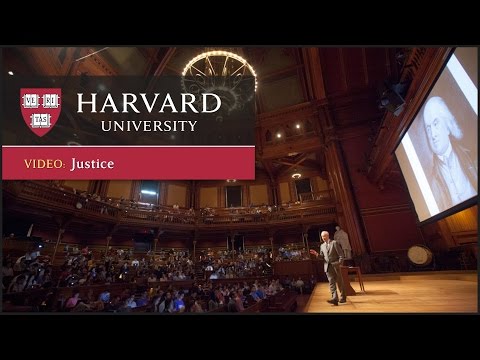
Part 1 - The Moral Side of Murder: If you had to choose between (1) killing one person to save the lives of five others and (2) doing nothing, even though you knew that five people would die right before your eyes if you did nothing—what would you do? What would be the right thing to do? That’s the hypothetical scenario Professor Michael Sandel uses to launch his course on moral reasoning. Part 2 - The Case for Cannibalism: Sandel introduces the principles of utilitarian philosopher, Jeremy Bentham, with a famous nineteenth century law case involving a shipwrecked crew of four. After nineteen days lost at sea, the captain decides to kill the cabin boy, the weakest amongst them, so they can feed on his blood and body to survive.